

Your baby is struggling to latch, feedings feel endless, and you cannot figure out why nothing is working. A small band of tissue called the lingual frenulum may be to blame, and when it is too short or tight, it creates a condition known as tongue tie, or ankyloglossia, that can affect feeding, speech, and oral development from birth.
At SoCal Pediatric Dentistry in Torrance, we guide families throughout the South Bay with compassionate, thorough evaluations as part of our comprehensive pediatric dental services, helping you find answers and a clear path forward.
What Is Tongue Tie?
Tongue tie occurs when the lingual frenulum connecting the underside of the tongue to the floor of the mouth is unusually short, thick, or tight, limiting how freely the tongue can move. The tongue plays a central role in nursing, eating, and forming speech sounds, so when its range of motion is restricted, the effects can show up at multiple stages of a child’s development. Some cases are mild, and the frenulum loosens naturally with growth, while others benefit from an early evaluation before function is meaningfully affected.
Signs of Tongue Tie in Infants
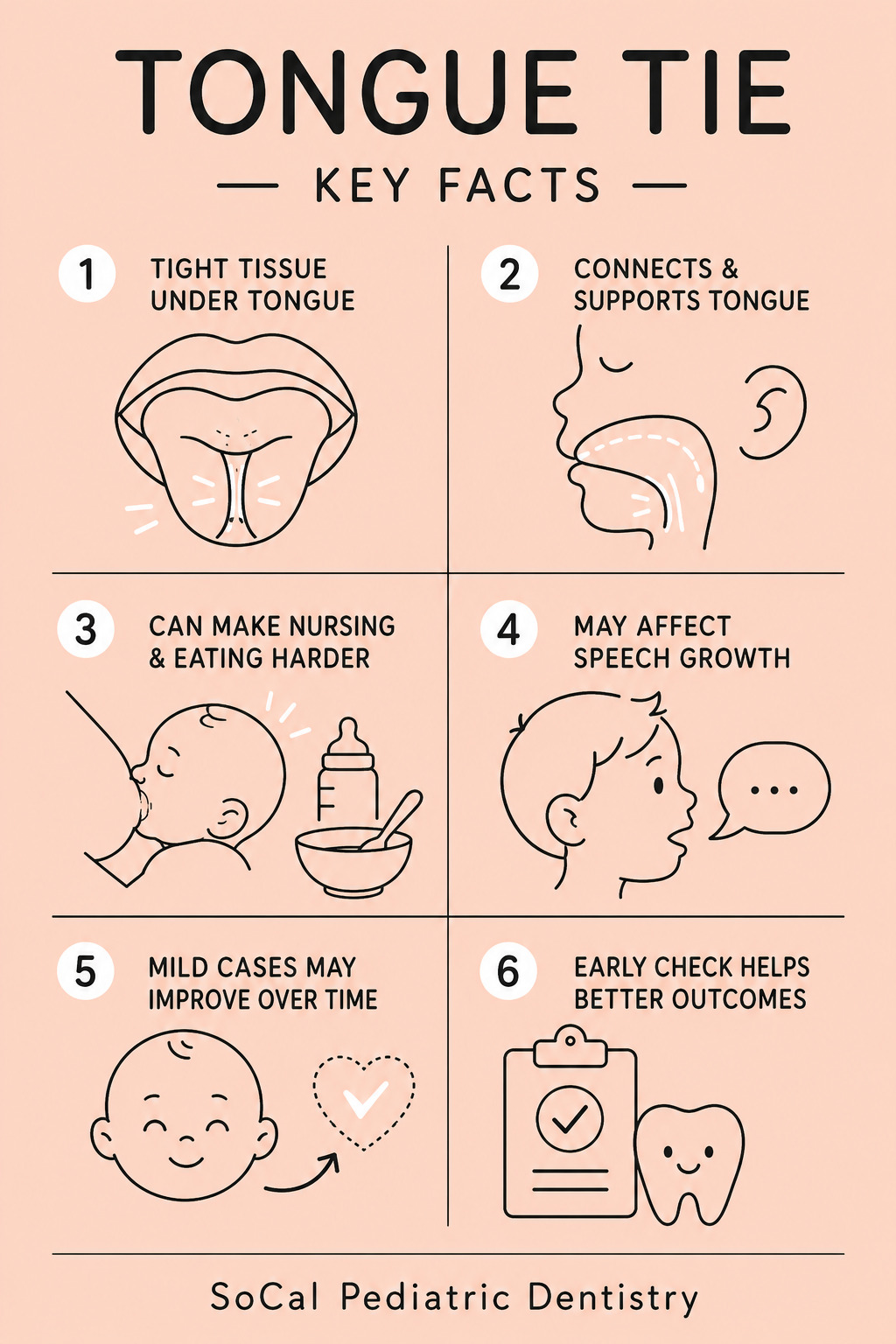
The earliest signs of tongue-tie often appear during breastfeeding, sometimes within the first days of a newborn’s life. Parents may notice feedings that go on far too long, a baby who repeatedly slips off the breast, or nursing pain that does not improve despite proper positioning. A visible notch or heart shape at the tip of the tongue when the baby cries, an audible clicking sound during feeding, or slower-than-expected weight gain can all point toward restricted frenulum movement.
The following are common infant-stage signals worth discussing with a provider:
- Latch difficulty: the baby cannot achieve or maintain a deep, comfortable latch and frequently pulls away.
- Poor milk transfer: feedings feel inefficient, the baby seems unsatisfied, and supplementation is increasingly needed.
- Nursing pain: the breastfeeding parent experiences significant nipple compression or soreness that does not improve with technique adjustments.
- Clicking or gulping: unusual sounds during feeding may indicate a loss of suction due to limited tongue movement.
- Heart-shaped tongue tip: a notch at the tip of the tongue, when extended, is a visible anatomical marker of tongue-tie.
If you are seeing these signs and breastfeeding support has not resolved them, a professional evaluation is the right next step. Our dental information resource can help you better understand what to look for and when to act.
Tongue Tie in Toddlers and Older Children
Tongue tie does not always show up in infancy. Some cases go unnoticed until a child is older and begins showing challenges with speech or eating. In toddlers and school-age children, parents and teachers may notice difficulty producing sounds such as “t,” “d,” “n,” “l,” “s,” “z,” or “r,” or a general pattern of unclear articulation that does not improve over time.
Functional Signs Beyond Infancy
Beyond speech, older children with unaddressed tongue tie may struggle to lick their lips, clear food from their teeth, or move their tongue side to side with ease. Some children experience discomfort as the frenulum stretches or catches on lower teeth during normal movement. These patterns can be subtle but meaningful, and they deserve a closer look from a provider who understands pediatric oral development well.
When Should You Seek Treatment?
Not every child with tongue tie requires treatment, and mild cases sometimes resolve on their own as the frenulum naturally shifts with growth. However, certain signals make an evaluation worth pursuing sooner. If nursing difficulties have persisted despite lactation support, if your toddler’s speech clarity is a consistent concern, or if your child seems physically limited in tongue movement, a professional assessment is the right call.
The American Academy of Pediatrics emphasizes the value of coordinated care from feeding specialists and dental providers to ensure accurate diagnosis and avoid unnecessary procedures. At SoCal Pediatric Dentistry, Dr. Bri evaluates each child individually, focusing on how the frenulum is affecting function rather than simply how it looks. Families new to our practice can learn what to expect by reviewing our first visit information.
How Is Tongue Tie Treated?
When treatment is recommended, the most common approach is a frenotomy, a quick release of the frenulum, restoring the tongue’s range of motion. At SoCal Pediatric Dentistry, we use the Solea CO2 laser to perform this procedure with precision and minimal discomfort, offering less bleeding and faster healing than traditional methods. For infants, the in-office procedure takes just minutes, and most babies can feed shortly after. Dr. Bri will walk you through post-procedure care so your child heals well and gets the most benefit from the release.
Schedule an Evaluation at SoCal Pediatric Dentistry
Dr. Brianne Hama is a Board-Certified Diplomate of the American Board of Pediatric Dentistry with residency training from NYU College of Dentistry and a DDS from USC. We care for children from infancy through adolescence, including those with special needs, and we bring genuine warmth and patience to every appointment. We accept most PPO insurance plans and offer a membership program for families without coverage.
If you have noticed signs of tongue tie in your infant or child, or simply have questions about oral development at any stage, we are here to help. Learn more about Dr. Bri and our team, and contact our office to schedule an evaluation today.